
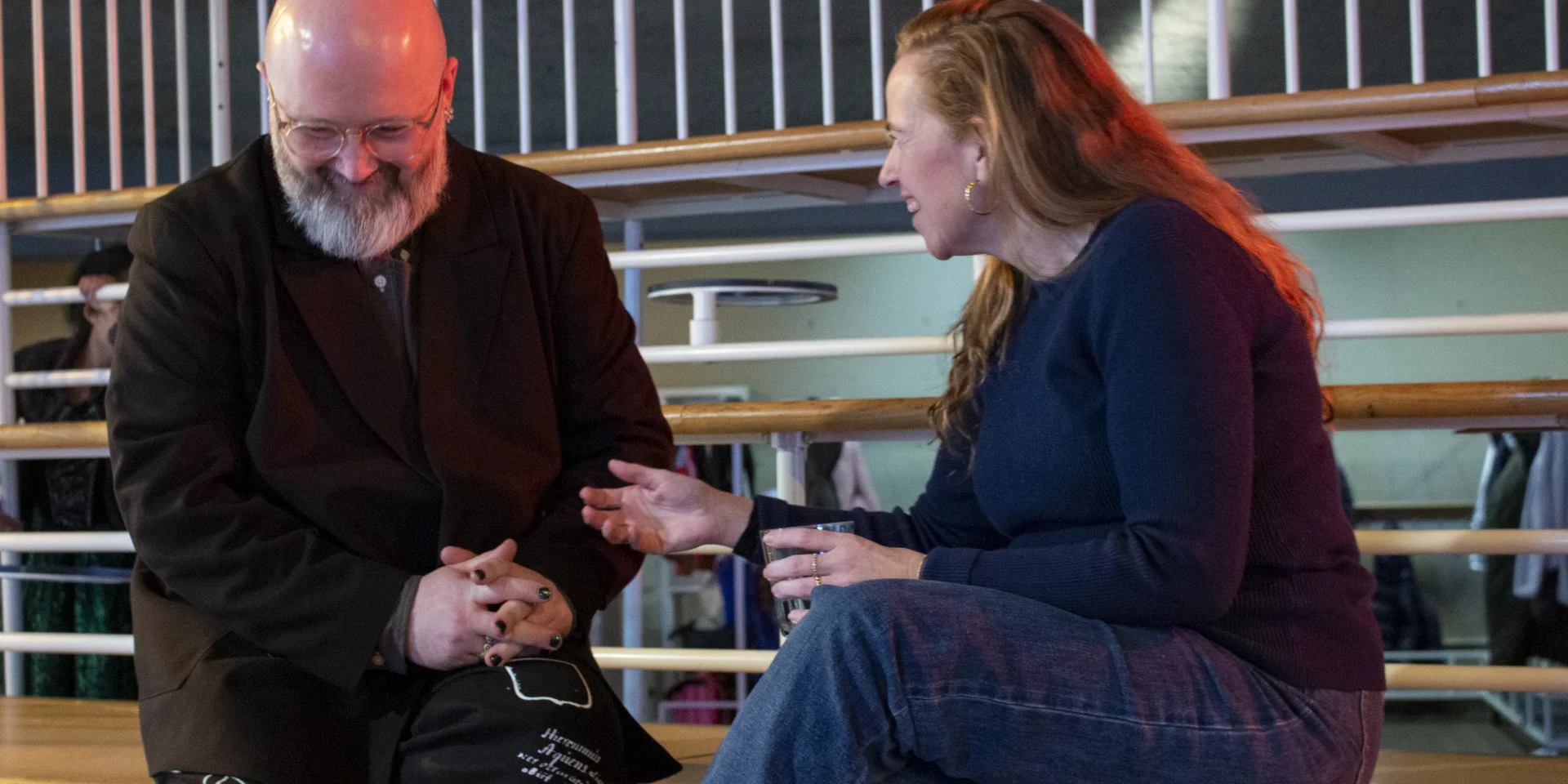
Angelo, why did you want to adapt a nineteenth-century novel for a young audience?
Angelo: Because it's a brilliantly beautiful book. Because it's full of themes that are close to my heart. And because I found the film adaptation so utterly dreadful that it was crying out for a new version (laughs).
A more faithful version?
Angelo: I hadn't read the book in a long time, so no. The average twelve-year-old isn't waiting around for a historically accurate stage play. And neither am I. Luckily, Henry James has been dead long enough that we can simply do whatever we like with the text.
Femke: When I said yes to Angelo's request to direct his script, he had only written ten pages. But I didn't hesitate. Like Angelo, I come from a broken home, and as a divorced mother I also know the other side. I can approach the subject with a know-how, an understanding of the vulnerabilities and sensitivities that come with it. It certainly helps that Angelo has described all of that beautifully and accurately.
The subject was once groundbreaking. Is it still?
Angelo: In Henry James' time, placing the perspective of a young child front and centre was revolutionary. People quite literally looked over children's heads back then. It was the era of corsets and addressing your parents formally. James puts Maisie forward right there in the title. For readers of the time, that was a revelation: children have feelings? Really?
Femke: Today it's no longer groundbreaking to place children at the centre, but that doesn't make it any less important. A young audience needs to feel heard and seen on stage. Divorces are far more common now, but that also makes them something "ordinary" that is spoken about less openly. Not every child has divorced parents, or the language to talk about it with friends. And adults still tend to explain very little to children during divorces — "because they won't understand anyway." That's harmful nonsense.
Angelo: A child is not an "unfinished" adult, but a thinking, feeling human being. That's why Wat Macy Weet is not only about the divorce itself, but also about the growing awareness that develops in children along the way. At a certain point, children look at their parents and wonder how they relate to these people. They discover that they are not small versions of their father or mother, but unique individuals capable of making their own choices. That sense of ownership is very present in the book and makes it recognisable to everyone. To children from twelve to a hundred.
Angelo's text is a gift. A gift I accept with gratitude — and then do my own thing with.
You shaped all of this into a monologue, performed by Hélène Devos. Why did you choose that form?
Femke: It's the first time I've directed a monologue. Aside from the musician on stage, Hélène and I are completely reliant on each other. But that's precisely what makes it interesting. You're forced to take care of one another. At the same time, Hélène can illuminate so many facets through her performance. That makes directing her something that comes naturally. She has a vulnerability to her, but at the same time you also see a strong girl.
Angelo: I studied with Hélène, but that's not why I suggested her to Femke. Objectively speaking, she is simply one of the best performers of her generation.
Femke: Directing a monologue like this is very intense, but I'm well supported at hetpaleis. As a child, I already felt very welcome at what was then the KJT (Royal Youth Theatre). That feeling has only grown stronger as I've watched this house develop over the years.
Is it easy for you to let go of your script, Angelo?
Angelo: I put my heart and soul into my scripts for film and theatre. They don't go to just anyone. I only hand them over with love and trust. Femke and I have been friends for more than twenty years, so I know she can do something with this.
Femke: Angelo's text is a gift. A gift I accept with gratitude — and then do my own thing with.
Angelo: A script isn't an IKEA instruction manual for building a specific cabinet. I see it more as a recipe for people who know how to cook. Femke is exactly that kind of person — someone who looks at the ingredients and can decide, on that basis, to give the dish a slightly different flavour.