Where does your connection come from?
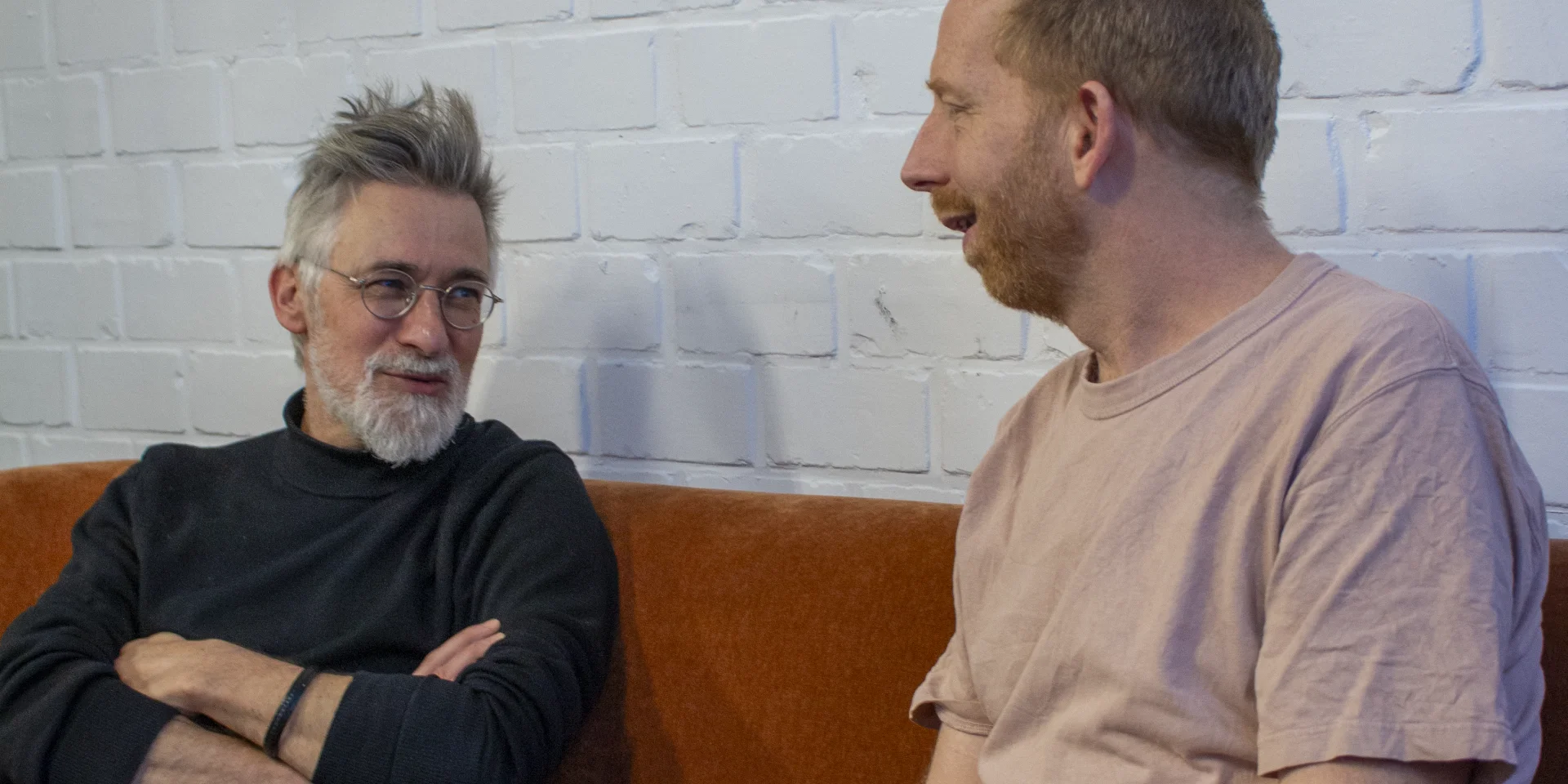
Jetse: It's incredibly cool to work with hetpaleis. A youth theatre with its own costume and set workshop? Even internationally, that scale and level of professionalism is unique — especially combined with the improvisational ability and flexibility they have in-house. On top of that, Koen thinks as a dramaturg but also as a maker, and that's a real pleasure.
Koen: Jetse is the kind of maker you can only dream of working with. The audience in our main hall is complex, but also a gift, and Jetse does things with a space like that which you've never seen before.
Such as?
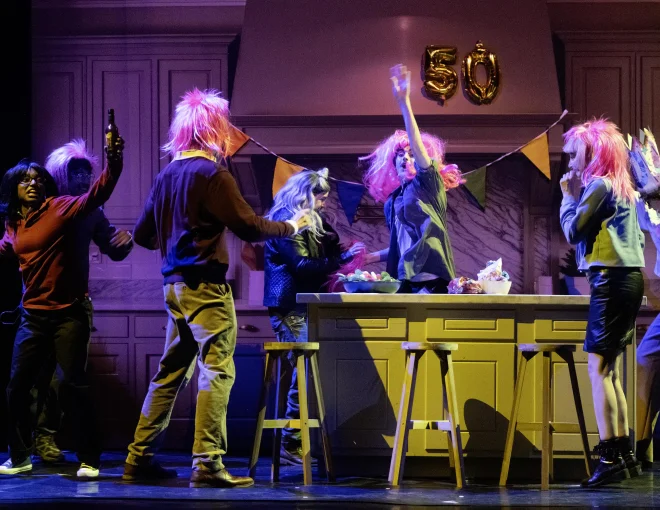
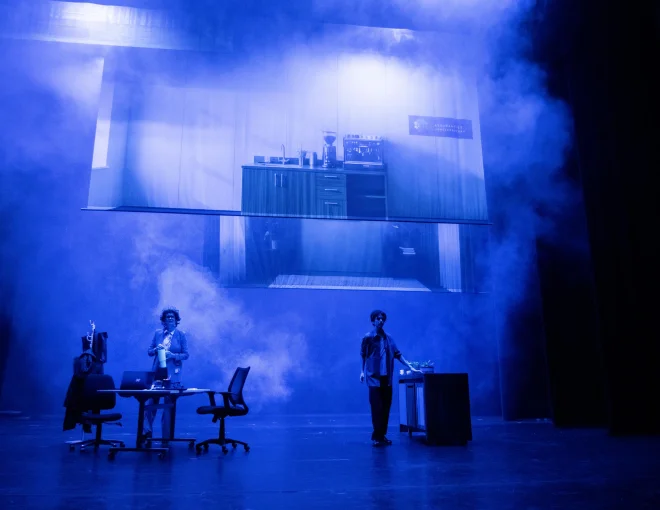
Jetse: s audience members, we've learned to behave ourselves nicely. We follow the unspoken rules that come with a large theatre hall without complaint. And it's precisely those codes I want to play with. We undermine expectations and see what territory opens up as a result. It's wonderful to make a hall roar thanks to the mechanical possibilities of side stages, curtains, and scene changes. When all the brakes came off during the finale of our show Een leuk avondje uit, I was moved myself — even though I knew exactly who was pulling which strings..
Koen: For Nu is het nog rustig, we're thinking of an inverted structure and want to start with the most overwhelming part.
How do you divide your roles?
Koen: Jetse usually comes in with a formal idea. I respond to that and try to think from the audience's perspective. Then we slowly start sharpening the content. Thanks to what the main hall makes possible, we can add a second, third, or fourth layer to it.
Jetse: I always find it terrifying when we start rehearsals, because at that point there's no script or text yet. But by then, Koen has already asked me so many good questions that I don't have to start from scratch. Our regular network of assistant directors, costume, set, sound, and lighting designers also helps me find my footing.
Koen: I have the advantage of having my hands free. Literally. While everyone else is performing, tweaking the sound, or sewing a costume, Jetse has to hold the entire group together. I can come to rehearsals with a fresh pair of eyes, which sometimes yields a great deal.
What image served as the starting point for this production?
Jetse: A flood on stage, in which the audience, the actors, and the characters are constantly scrambling to keep up with events.
Koen: The idea of "simultaneity" is very important in that. In the rat race of life, so many things are happening at once. Where do you look? And aren't we focusing too hard on the wrong things within that constant stream of information?
Jetse: Just as in real life, children are spectators of that adult chaos. They can still look at it with an outside eye.
I find it interesting to mobilise children in their strength and their rebellion. We dare to tease children a little, and they tease us back
You're touching on something there. In your work, you give children space to practice resilience and uncertainty. What view of people — and of children — do you start from when creating new productions?
Jetse: I find it interesting to mobilise children in their strength and their rebellion. We dare to tease children a little, and they tease us back. That takes courage on both sides.
Koen: Jetse creates an egoless world on stage. And if there is ego, he looks at it with great compassion. That sets something in motion in children's minds. What would happen if we let go of that ego in society too? That's a reassuring vision of humanity. You don't have to be the centre of the world.
Jetse: t's liberating when you don't have to become a superhero (laughs). By being overprotective of children, you make them the centre of everything. But the reality they're growing into isn't always predictable, safe, and warm. For me, theatre is the ideal place to let children practise with chaos, unpredictability, and discomfort. I have a great deal of faith in the fact that they can handle it.
What do you want to happen, then?
Jetse: Something unexpected? What moved me, for example, was how after our production The End of the Beginning of the End, entire groups of children left the theatre walking backwards — how actors even spotted children walking backwards through the city kilometres away. That's worth its weight in gold. Or when the entire audience whispers projected sentences together, or when eighty-year-old grandparents crouch under their seats because we ask them to. That's almost a form of mass hypnosis.
The title Nu is het nog rustig (Now It's Still Quiet) feels like a threat. Is that intentional?
Jetse: Our titles always create expectations — including for ourselves: they're often the only anchor we have before we begin a production. So if there's a kind of tension in it, I immediately like that. There is indeed something threatening about it: "enjoy the calm while it lasts, because soon things will be very different."
Koen: And you can also think about it in social terms: what else is still in store for us?