

How are things going?
Lisi: Really well. I'm incredibly excited to start the creation of RAFAGA. I enjoy working in short, intensive blocks. That format also works perfectly for the performers; they're all very different and have different needs.
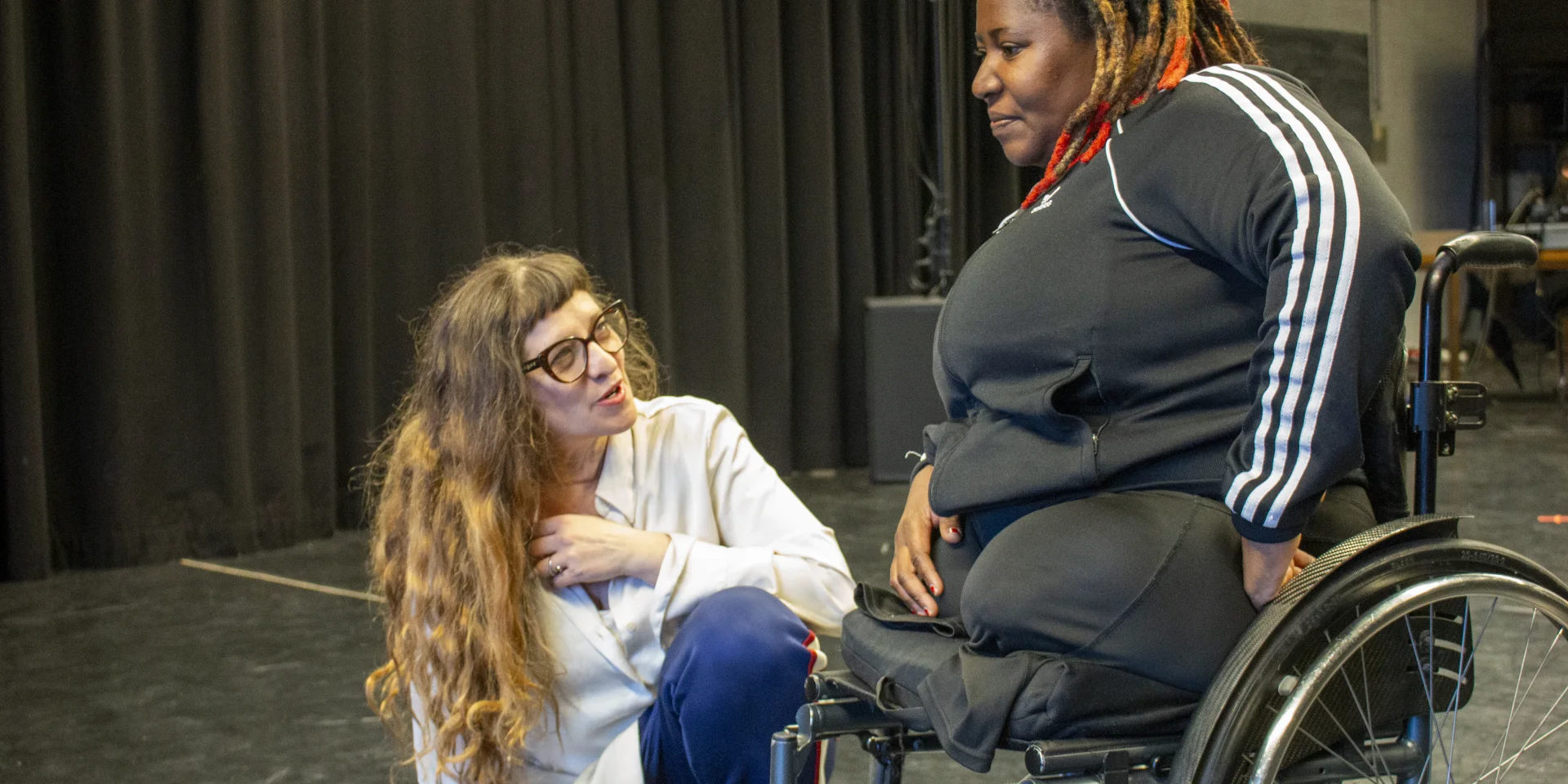
Mariana: It's wonderful to be able to experience the entire creative process. With Lisi's previous production, What We Can Do Together, which was shown at hetpaleis in February 2025, I only became involved later on. I had no idea how the production had come about or been built. Now it feels like a gift to experience from the very beginning how Lisi works with the group and how she encourages them.
How does she do that?
Mariana: There's a great openness. Lisi tries to understand every suggestion from the group and do something with it. She explains what she wants in a very natural way and shows how we can get there. She makes no distinction between herself and the performers. We are different, but we work together. She gives us time and freedom.
Lisi: Later in the process there may be a little more pressure, but the beginning of the rehearsal period feels like a real playground. Anything can happen.
In What We Can Do Together you created a paradise on stage. Will you do that again?
Lisi: It will be a very different production, but there is something utopian in my work in recent years. The audience needs to want to be part of the world on stage. It's a paradise full of tensions, showing what it would be like if we truly engaged with different kinds of people — not just those who also live in our bubble. That's not a political statement, but it is a subtle message.
What does "rafaga" actually mean?
Lisi: Rafaga is a sudden wind that sets change and transformation in motion. It's something that comes from outside, something we cannot control. For me it's also connected to nature and how we as city dwellers look at it, and to the future fantasies of the performers. Like a kind of science fiction, I want to stage possible realities. What is possible after the end of the world?
How important is the composition of your cast?
Lisi: It's the most important thing of all. I don't just work with different bodies, but also with different ways of thinking. It's about what their fantasies are, what they want to talk about, what they want to defend on stage.
This time you're also working with children on stage.
Lisi: That's right. But I see little difference in working with adults. I treat everyone the same way and give them the same instructions. What's characteristic of most children is that they have almost no filters. If they're sad, they're sad. If they don't like something, they just say so. I love their honest communication.
Mariana: For me it took a little getting used to. I had never worked with children before. They have so much energy and so much to say (laughs). But as soon as I made the shift in my mind from "these are children" to "these are dancers," I was able to really enjoy it.
How do you find your dancers, Lisi?
Lisi: Some dancers I've worked with for a long time; others I find through inclusive dance groups such as Platform K. I met Mariana through an inclusive organisation from Madeira when I was looking for someone who uses a wheelchair. I saw a few images of her and immediately knew I
What does dancing mean to you, Mariana?
Mariana: I started dancing about twenty years ago, when a friend invited me to an inclusive dance workshop. I was shocked by the number of participants, because in Mozambique at the time you rarely saw anyone with a disability in public. I felt very uncomfortable and promised myself I wouldn't go back. But four days later I was there again — to "have a look." The choreographer, Panaíbra Gabriel Canda, gave me a great deal of time. He encouraged me not to stay in my wheelchair, but to use the floor. At first that felt very small to me. But now I use that space, and I can move through it very quickly. It has become my freedom. I've never stopped dancing.